Cyrusher's Abandoned Cart Flow, Email by Email
We left a $1,499 e-bike in a Cyrusher cart. An eight-step flow in six days, a support agent who wasn't typing, and a $1,799 price that comes and goes.
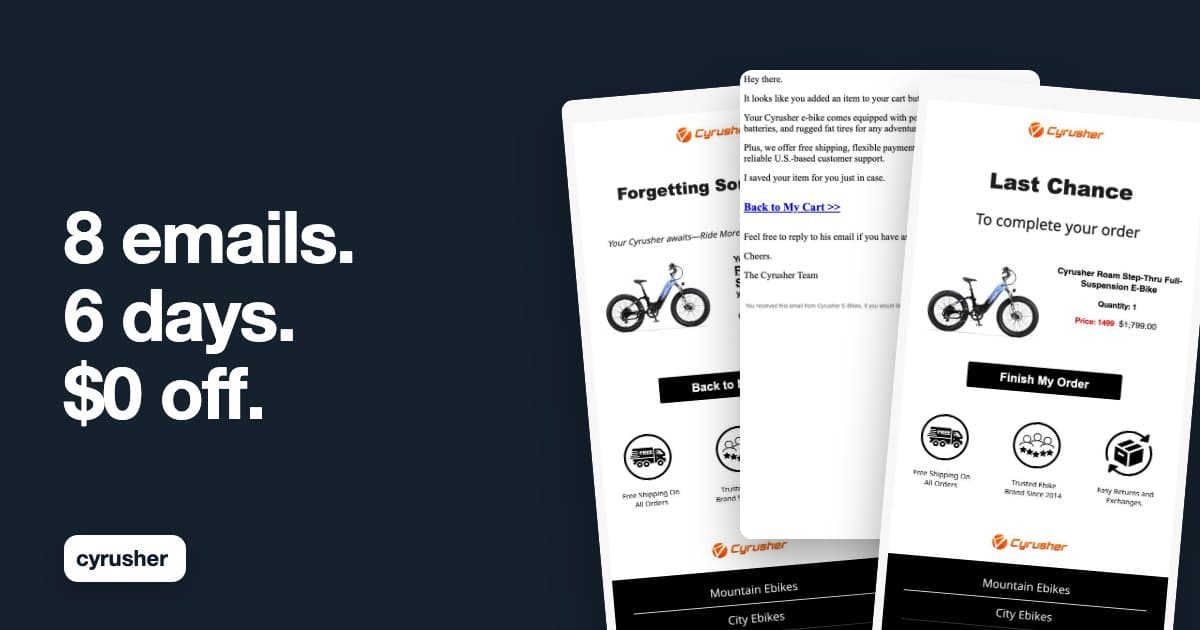
We put a $1,499 Cyrusher e-bike in a cart and walked away. Over the next six days, an eight-step cart flow landed. And then some.
The price never moved. Every email that shows a number shows $1,499.
Plenty of other things moved instead. Here's the run, email by email.
Eight steps in six days
The branded steps fire roughly once a day, each at almost the same minute. That clock is probably an echo of the moment we abandoned — flows run on offsets, not a hand-picked send time. Here are seven of the eight; email 2 breaks the pattern, so it gets its own section below.
Cyrusher Ebikes
You left something behind…🤔
OpenCyrusher Ebikes
Your cart was VERY we message you👍
OpenCyrusher Ebikes
Quick heads up
OpenCyrusher Ebikes
Here's why you loved it 😍
OpenCyrusher Ebikes
The people have spoken!
OpenCyrusher Ebikes
Are you sure you want to let this go?
OpenCyrusher Ebikes
Your order is expiring
OpenThe run skips March 8, then closes with a doubled finale: emails 7 and 8 land 29 seconds apart on day 6, on the same "Last Chance" template.
Worth a close look: several steps print the cart total as "Total Price: 1499.0" — raw merge output, no dollar sign, unfixed across the whole run.
Email 2 says it's from Ivory
Six hours after email 1, at 00:18 UTC, a plain-text note arrived. No logo, no buttons, signed by a support agent named Ivory. It offers help with payment verification issues and a link to finish the purchase on the brand's official Amazon store.
Ivory - Cyrusher US
Hi, this is Ivory from Cyrusher Ebikes. I noticed you had some items in your ...
OpenIt reads like someone typed it just for us. The rest of the inbox suggests otherwise.
Two days later we carted a different bike and the flow started over — the same note arrived, word for word. And about an hour after each send, a "Chat transcript" receipt followed, re-showing Ivory's message as a chat bubble. "Thanks for chatting with us!" — for a chat that never happened.
Ivory - Cyrusher US
Hi, this is Ivory from Cyrusher Ebikes. I noticed you had some items in your ...
OpenCyrusher US
Chat transcript (#883)
OpenCyrusher US
Chat transcript (#7f6)
OpenThis looks like a chat automation dressed as a personal check-in. The transcript receipts are the tell — the system mails you the evidence of its own template.
The $1,799 that comes and goes
Most steps in this flow arrived twice: two variants of the same creative, seconds apart. An A/B test, or a quirk of how our cart was subscribed? We can't tell from the outside.
But both variants exist, and they disagree on the price. One shows it plain. The other adds a struck-through $1,799.00 — and the doubled finale does it too: email 8 carries the strikethrough that email 7, 29 seconds earlier, doesn't.
Here's the pair from March 8:
The sell price is $1,499 in both. The anchor flickers on and off depending on which variant fires, not on how long you've waited. And the same $1,799 figure appears on both bikes we carted, which looks like a hardcoded value rather than a live list price.
Does any of it work? Only Cyrusher knows. What we can say: in every email shown here, the bike costs $1,499.
What we noticed
- Eight steps in six days, and in every email shown here the price held at $1,499. The urgency escalates; the offer doesn't — the first coupon only surfaced days after this window.
- The plain-text agent email is the most interesting step. A name and no template read differently — and the transcript receipts show it's fully canned. Only the brand knows if it converts.
- The $1,799 strikethrough behaves like a template variant, not a markdown. It appears and disappears between twin sends while the sell price stays put.