Quince's Favorite Discount Is a Competitor's Price
In 28 Quince emails, the markdown machinery points outward: "vs. traditional retail" strikethroughs, a $148 rival price tag, and not one code.
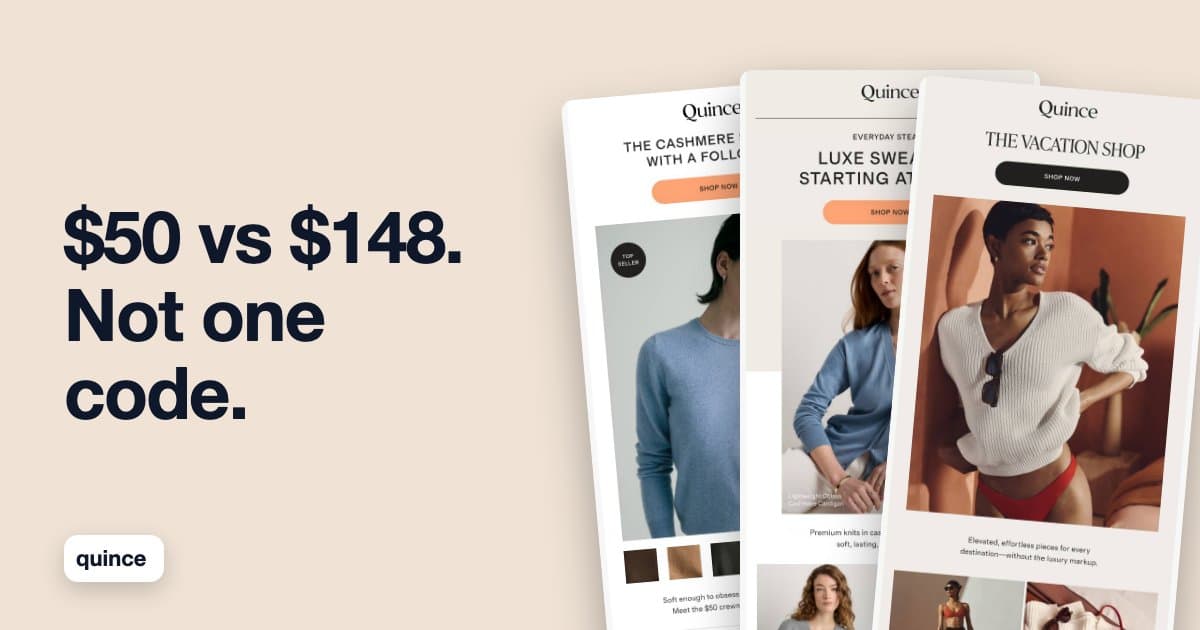
Quince's emails are full of strikethroughs, savings percentages, and "was" prices. Almost none of them are Quince's. In the 28 emails in our sample, December 23 to March 25, the discount machinery points outward — at J.Crew, at Everlane, at "traditional retail" — while Quince's own price mostly stays exactly where it is.
The table that does the discounting
The clearest version is the $50 cashmere crew send from January 7. A comparison table lines up Quince at $50.00 against J.Crew at $148.00, Everlane at $178.00, and Naked Cashmere at $295.00 — then computes the savings for you: 66%, 72%, 83%. A markdown-sized number, and nothing was marked down.
We caught two versions of that email minutes apart — this looks like a test of which argument fronts the table. One leads with the price and savings rows; the other drops them for "100% Grade-A Mongolian Cashmere" checkmarks. Dollars or grade — the product and the $50 never move.
The everyday anchor kit
On ordinary sends, the same move runs in smaller type. Strikethroughs are labeled "vs. traditional retail" — $50.00 against a struck $148.00 — and roundels shout "$50 JEANS". One January email's hero button isn't a verb at all: the CTA reads "STARTING AT $29.90".
Small self-markdowns do exist in the mix — "Bundle & Save" tiles, a skincare "Save up to 30%". But they sit low in the scroll, in small type. The loud numbers are other retailers' prices.
Full price, selling fast
Where other brands would drop a code, Quince counts stock. Restock emails carry "SELLING FAST" badges over full-priced tiles, and a March 1 send explains the logic in one line: "When luxury is this accessible, it'll always sell out." Scarcity, argued through the value story instead of a deadline discount.
When Quince does mark down
Twice in our sample, Quince stages a full deal day: December 26 ("End of Year Sale. One day only. Up to 30% off.") and March 25. Both are the longest emails in the set — stacked "TODAY ONLY" spotlights with itemized was/now prices and a countdown clock in the hero.
Even here, no code. Each markdown is a specific item at a specific new price — "Was $119.90 Now $94.90" — valid for one day, while supplies last. The sale is an event with an inventory, not a coupon.
Launches hide the prices entirely
The February 25 vacation-collection launch goes the opposite direction: serif headlines, black buttons, editorial photography — and not a single price or discount anywhere in the body. For a brand this anchored to numbers, the launch email is the one place Quince sells like the luxury houses it undercuts.
Quince
Just landed: the vacation shop
OpenThe $5 that quietly left
One real incentive did exist: the footer's dark SMS block read "SIGN UP FOR SMS & GET $5" through December and January. By February 27 the same block says "SIGN UP FOR TEXTS" — the $5 is gone, and it's still missing on March 1. The $20 referral reward survives untouched.
A price-anchoring brand removing its last small bribe fits the pattern. Whether it was a test, a margin call, or a cleanup, only Quince knows.
What we noticed
- In the 28 emails we sampled over three months, not one carries a discount code. The loudest markdown visuals — strikethroughs, savings percentages, comparison tables — price Quince against other retailers, not against itself.
- Full deal days happen twice in the sample, staged as one-day events with itemized was/now prices; launches drop prices entirely. The value story flexes by occasion, but the hero-product anchors hold.
- The one small cash incentive in the footer — $5 for an SMS signup — disappeared mid-window. Whether the anchoring-only posture converts better than couponing, only Quince knows.